Skip to content


Tyres are one of the most important. and most neglected parts of any car. Most drivers only think about them when something goes wrong. But with a handful of consistent habits, a set of tyres can last significantly longer than average and cost you far less over time.
Whether you drive daily through town, commute along busy A-roads, or cover longer distances between villages and retail parks, your tyres are working on every single journey. The wear is cumulative. The factors that shorten their life are largely within your control.
This guide covers everything you need to know to get the maximum safe mileage from your tyres, written specifically for UK drivers, backed by verified data, and compiled by the technicians at G4 Tyres & Wheels who see the results of tyre neglect every day.
How Long Should Tyres Last?
Most car tyres in the UK last between 20,000 and 50,000 miles under normal driving conditions, roughly three to six years for a driver covering average annual mileage. The wide range reflects how dramatically habits and maintenance affect lifespan.
- 20K–50K – Miles: typical tyre lifespan range
- 1 in 5- Motorway breakdowns caused by tyre issues (National Highways)
- £2,500 – Maximum fine per illegal tyre in the UK
- 44% – Rise in penalty points issued for illegal tyres in 2024 (DVLA data)
Table 1 – Tyre Lifespan by Driving Habit
| Driving Style | Typical Lifespan | Key Factor |
| Careful / mostly motorway | 35,000 – 50,000 miles | Smooth acceleration, even braking, good pressure habits |
| Average mixed driving | 20,000 – 35,000 miles | A combination of urban stop-start and open roads |
| Aggressive / mostly urban | 10,000 – 20,000 miles | Hard braking, fast cornering, poor tyre care |
Why Tyres Wear Out Faster Than They Should
Most premature tyre wear does not come from one dramatic event. It builds gradually from a combination of factors that individually seem minor but together remove months, sometimes years- from a tyre’s useful life. The main culprits are:
- Incorrect tyre pressure, too high or too low, which changes how the tyre contacts the road
- Misaligned wheels, causing the tyre to scrub sideways as it rolls rather than rolling cleanly
- Aggressive driving: hard braking, sharp acceleration, fast cornering
- Neglected tyre rotation, leaving front tyres to carry a disproportionate load
- Overloading the vehicle, putting excess strain on the sidewalls, and generating heat
- Age and environmental degradation, which affect rubber compounds regardless of mileage
10 Tips To Make Your Tyres Last Longer
Small tyre care habits can save you money, improve safety, and help your tyres perform better for longer. Follow these simple tips to reduce uneven wear and get the best value from every set of tyres.
01. Check Your Tyre Pressure Every Single Month
If there is one habit that makes the single biggest difference to how long your tyres last, it is this one. Tyre pressure affects everything: wear rate, fuel efficiency, braking distance, and the risk of blowouts. Yet research from National Highways found that only one in six drivers checks their tyres before a long journey.
Table 2 – Effects of Incorrect Tyre Pressure
| Condition | Effect on Tyre Wea | Effect on Vehicle | Status |
| Underinflated | Outer edges wear rapidly; sidewall flexes excessively, generating damaging heat | Poor fuel economy, sluggish handling, increased blowout risk | Harmful |
| Correct pressure | Even tread wear across the full contact patch | Optimal grip, fuel efficiency, predictable handling | Ideal |
| Overinflated | Centre tread wears down faster; shoulders remain largely unused | Harsh ride, reduced traction, greater vulnerability to pothole damage | Harmful |
How to check correctly:
- Check pressure when tyres are cold, before driving or after at least two hours parked
- Find your vehicle’s recommended PSI on the sticker inside the driver’s door jamb or in the owner’s handbook, not on the tyre sidewall
- Use a reliable digital or manual pressure gauge and check all four tyres, plus the spare
- Adjust for load, many vehicles specify a higher pressure when carrying passengers or luggage
- Repeat every four weeks and after significant temperature changes (pressure drops roughly 1 PSI per 10°F fall)
Do not rely solely on TPMS. All cars manufactured after 2014 are fitted with a Tyre Pressure Monitoring System, but it only alerts you when pressure has already dropped significantly. By the time the warning light appears, wear acceleration has often already begun. Manual monthly checks remain essential.
02. Get Your Wheel Alignment Checked Regularly
Wheel alignment is one of the most underestimated factors in tyre longevity. When wheels are correctly aligned, each tyre rolls in a straight, clean path. When alignment is even slightly off, the tyre scrubs against the road at an angle with every rotation, eating through tread rapidly and unevenly, often in a pattern that only becomes obvious once significant damage has already been done.

Signs of misalignment to watch for:
- Rapid or uneven tread wear – particularly on one edge of the tyre
- The vehicle pulling or drifting to one side on a straight road
- The steering wheel sitting fractionally off-centre when driving straight
- Steering wheel vibration or scrubbing noises at low speeds
Common causes include hitting a kerb or pothole (even at low speed), wear in suspension components over time, and carrying heavy loads regularly without adjusting tyre pressure. Alignment should be checked at least once a year as a minimum, and immediately after any significant impact.
G4 Tyres & Wheels offers professional wheel alignment checks. Book your alignment check today
03. Rotate Your Tyres Every 6,000 to 8,000 Miles
On a front-wheel-drive car, which accounts for the majority of vehicles on UK roads, the front tyres handle steering, braking, and the transfer of engine power to the road simultaneously. The rear tyres, by comparison, have a relatively easy life. The result: front tyres wear at roughly twice the rate of rear tyres.
Rotation addresses this by periodically moving tyres between axle positions to distribute wear more evenly across the whole set. The recommended interval for most passenger cars is every 6,000 to 8,000 miles, though your vehicle handbook may specify a different figure.
What a standard rotation involves:
- Front tyres move to the rear on the same side
- Rear tyres cross to the front on opposite sides (for non-directional tyres)
- Directional tyres are moved front to rear on the same side only, never crossed
- All four tyre pressures were rechecked and adjusted after rotation
Rotation is typically carried out at the same time as a service or oil change, making it easy to combine with visits you are already planning.
04. Balance Your Tyres
Tyre balancing is often confused with alignment, but they address different problems. Alignment corrects the angle at which tyres meet the road. Balancing ensures the weight of each wheel-and-tyre assembly is distributed evenly so no single point is heavier than the rest.
Even slight imbalances cause vibrations, accelerate uneven tread wear, and place extra strain on wheel bearings and suspension components. You will typically feel the effect as a vibration through the steering wheel or seat at certain speeds.
When to have tyres balanced:
- Whenever new tyres are fitted
- After each tyre rotation
- Any time you notice vibration at speed
- As a general rule, every 5,000 to 6,000 miles
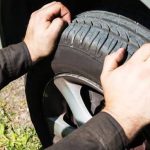
05. Inspect Your Tyres Visually Every Few Weeks
A monthly visual inspection takes approximately two minutes and can catch problems that, left unnoticed, lead to blowouts or MOT failures. Here is what to look for:

- Bulges or bubbles on the sidewall – These indicate internal structural damage, usually from a hard pothole or kerb impact. A bulge means the inner lining has failed. This is not repairable. Replace the tyre immediately.
- Cracking or crazing on the sidewall – Fine surface cracks develop as rubber ages. Deep or widespread cracking means the tyre’s structural integrity is compromised.
- Uneven tread wear – Wear on one edge points to misalignment. Centre-only wear suggests chronic overinflation. Wear on both outer edges suggests chronic underinflation.
- Embedded objects – Nails and screws frequently embed in the tread without causing an immediate puncture. Catching them early prevents the slow leak from becoming a sudden deflation at speed.
- Cuts or gouges – Any cut on the sidewall requires professional assessment without delay.
06. Understand UK Tyre Law – and Why 3mm Is the Smarter Limit
The legal minimum tyre tread depth in the UK is 1.6mm, measured across the central three-quarters of the tyre around its full circumference. Dropping below this limit while driving is a criminal offence under Section 41A of the Road Traffic Act 1988.
Legal risk: Each illegal tyre carries a fine of up to £2,500 and three penalty points. Four illegal tyres on one vehicle could mean a £10,000 fine and enough points to trigger licence disqualification.
Table 3 – UK Tyre Tread Depth Guide
| Tread Depth | Status | Action Required |
| 4mm or above | Good | Monitor regularly with monthly checks |
| 3mm | Plan replacement | Wet braking distances begin increasing significantly, so start budgeting for new tyres |
| 1.6mm Legal minimum | Replace immediately | Replace immediately. This is the legal floor, not a safe target |
| Below 1.6mm | Illegal | Do not drive, criminal offence, fine of up to £2,500 and 3 penalty points per tyre |
The 20p Coin Test
- Insert a 20p coin into the main tread groove, outer band facing inward
- If the outer band is hidden by the tread, your depth is above 1.6mm
- If the outer band is visible, the tyre is at or below the legal limit. Replace it immediately
- Repeat across multiple points around the tyre and in different grooves, as wear is rarely perfectly uniform
This test gives a reliable, quick indication at home. For a precise reading, use a tread depth gauge or ask a technician. Not sure about your tread depth? Book a free tyre check at G4 Tyres & Wheels.
07. Adjust Your Driving Style
This is the section most drivers read while thinking it applies to someone else. The reality is that everyday habits, not just track-day antics, cause significant cumulative tyre wear over time.
Hard braking forces the tyre to shed speed rapidly through friction with the road surface. Done habitually, it removes measurable tread with every instance. Sharp acceleration produces the same result at the drive axle, even minor wheelspin scuffs rubber off the tread surface. Fast cornering creates lateral forces that push the tyre against the road sideways, degrading the compound and causing uneven wear across the tyre width.
Practical adjustments that genuinely help:
- Increase the following distance so braking can be progressive rather than sudden
- Accelerate smoothly from a stationary position, especially in wet conditions
- Reduce entry speed into bends rather than braking mid-corner
- Slow down properly for speed bumps; the impact at 20 mph versus 10 mph is considerably greater than it feels
- Avoid mounting kerbs when parking; sidewall contact with a kerb edge is one of the fastest ways to cause irreparable damage
08. Do Not Overload Your Vehicle
Every tyre has a load index, a rating specifying the maximum weight it is designed to carry at its recommended pressure. Exceeding that limit does not cause immediate failure in most cases, but it places the tyre under sustained stress it was not built to handle.

Overloading compresses the sidewall excessively, generates additional heat, and increases rolling resistance; all three effects accelerate wear and increase the risk of a sudden blowout, particularly on longer journeys or during summer months.
- Check your vehicle’s maximum load capacity in the handbook and the load index stamped on the tyre sidewall
- Remove items from your boot that serve no purpose on most journeys. Unnecessary weight is one of the most overlooked contributors to excess rear tyre wear
- If towing, ensure your tyres are rated for the combined weight, and that pressure is adjusted accordingly
- Distribute weight evenly; an unevenly loaded vehicle places more stress on one axle, accelerating wear asymmetrically
09. Choose the Right Tyres From the Start
Everything in this guide applies more effectively when you start with a tyre correctly matched to your vehicle, your driving patterns, and the roads you use most. A tyre outside the correct specification will wear faster, perform worse, and cost more to run, regardless of how diligently you maintain it.
Table 4 – Tyre Type Comparison for UK Drivers
| Tyre Type | Best For | Typical Lifespan | Key Trade-off |
| Premium brand | High mileage drivers, safety-focused | Longer, superior rubber compound | Higher upfront cost; better value over time |
| Mid-range | Average mileage, mixed use | Moderate | Balanced cost and performance |
| Budget | Low mileage, tight budget | A shorter wear rate is typically higher | Lower upfront cost; often more expensive over the lifetime |
| All-season | UK conditions temperature fluctuates year-round | Variable by brand | Practical compromise; no seasonal changeover needed |
| Winter | Frequent cold/ice/snow driving below 7°C | Long if used seasonally only | Must switch back to summer above 7°C for best performance |
Stick to the same brand on the same axle where possible. Different manufacturers use different rubber compounds that wear at different rates, mixing them creates uneven handling and accelerated wear on one side.
Not sure which tyre suits your vehicle and driving style? Ask the G4 team, we’ll find the right match for you.
10. Factor in Tyre Age – Even When Tread Looks Fine
A tyre that has covered very few miles can still be unsafe if it is old enough. Rubber is an organic compound and degrades over time regardless of use. Exposure to heat, UV light, ozone, and oxygen gradually hardens and dries the compound, reducing grip and increasing the risk of cracking or sudden structural failure.
Most tyre manufacturers recommend tyres be inspected annually once they pass five years of age, and replaced no later than ten years from the date of manufacture, regardless of remaining tread depth.
How to Check Your Tyre’s Age (DOT Code)
- Find the DOT code moulded into the tyre sidewall
- The last four digits indicate the week and year of manufacture
- Example: 2419 = manufactured in the 24th week of 2019
- Any tyre over five years old should be inspected annually by a professional
- Replace any tyre over ten years old, regardless of tread depth
Age matters most for spare tyres (often fitted and forgotten), low-mileage vehicles, and second-hand cars where the tyre history predates your ownership.
Your Simple Tyre Maintenance Schedule
The most effective tyre maintenance programme is one that does not require you to think about it separately from everything else you do for your vehicle. Build tyre checks into your existing routine, and nothing gets missed.
Table 5 – Recommended Tyre Maintenance Schedule
| Frequency | Task | Time Required | Cost |
| Monthly | Pressure check on all four tyres + spare; visual inspection for damage, embedded objects, and uneven wear | ~5 minutes | Free |
| Every 6,000-8,000 miles | Tyre rotation; recheck and adjust pressures after rotation | ~30 minutes | Low |
| Every 5,000-6,000 miles | Tyre balancing, especially after fitting new tyres or if vibration is felt | ~30–45 minutes | Low |
| Annually | Wheel alignment check; DOT code age assessment; tread depth measurement with gauge across all four tyres | ~30 minutes | Low–moderate |
| After any significant impact | Inspect affected tyre and check wheel alignment before covering significant further mileage | ~15–30 minutes | Free inspection at G4 Tyres & Wheels |
Warning Signs Your Tyres Need Replacing Now
Do not wait for an MOT to flag a tyre problem. If you notice any of the following, have the affected tyre assessed by a professional without delay.
Table 6 – Tyre Warning Signs & What They Mean
| Warning Sign | Most Likely Cause | Action |
| Rapid or repeated pressure loss | Puncture, valve issue, or damaged bead | Inspection immediately, do not continue driving on a deflating tyre |
| Vibration through steering wheel or seat at speed | Wheel imbalance or alignment issue | Wheel balance and alignment check |
| Vehicle pulling to one side | Misalignment, uneven tyre wear, or brake issue | Alignment and brake inspection |
| Bulge or blister on sidewall | Internal structural damage, tyre lining has failed | Replace the tyre immediately, do not drive on it |
| Cracking or crazing on sidewall | Age-related rubber deterioration | Professional assessment, may require immediate replacement |
| Tread wear indicators visible | Tread at or near 1.6mm legal minimum | Replace before reaching the legal limit |
| Scrubbing or squealing noises at low speed | Misalignment or suspension wear | Alignment and suspension check |
Frequently Asked Questions
How Long Should Tyres Last in the UK?
Most car tyres in the UK last between 20,000 and 50,000 miles under normal driving conditions, roughly three to six years for a driver covering average annual mileage of 7,000 to 10,000 miles. Premium tyres with better rubber compounds tend to achieve the higher end of that range. Tyre age also matters independently of mileage; most manufacturers recommend replacing tyres no later than ten years from the date of manufacture, regardless of remaining tread.
Does wheel alignment really affect Tyre Wear?
Yes, significantly. Even a slight misalignment causes the tyre to scrub sideways as it rolls rather than rolling cleanly forward. This generates uneven wear, often concentrated on one edge of the tread, and can reduce tyre life by a third or more compared to a correctly aligned vehicle. The effect builds gradually, which is why it often goes unnoticed until substantial damage has already occurred.
Does tyre pressure affect how quickly tyres wear out?
Incorrect pressure is one of the leading causes of premature tyre wear. Underinflation causes the outer edges of the tread to wear faster because more of the tyre’s surface area contacts the road. Overinflation concentrates wear in the centre of the tread. Both conditions also increase fuel consumption and reduce handling precision. Checking pressure monthly and maintaining the manufacturer’s recommended PSI is the most cost-effective tyre maintenance step available to any driver.
What is the Legal minimum tyre tread depth in the UK?
The legal minimum is 1.6mm across the central three-quarters of the tyre around its full circumference. However, safety professionals recommend replacing tyres at 3mm because wet weather stopping distances increase substantially below this point. At 1.6mm, stopping distances in wet conditions can be up to 44% longer than at 3mm. Driving below the 1.6mm limit carries a fine of up to £2,500 and three penalty points per tyre.
What happens if I drive on illegal tyres in the UK?
Driving on tyres below the legal tread depth limit is a criminal offence. Each illegal tyre can result in a fine of up to £2,500 and three penalty points on your licence. With four illegal tyres, the combined fine could reach £10,000, and the accumulated points could trigger licence disqualification. Illegal tyres can also invalidate your motor insurance policy, leaving you personally liable for costs arising from any accident.
Is it worth paying more for Premium Tyres?
For most drivers, yes, particularly those covering higher annual mileage. Premium tyres from established manufacturers generally use superior rubber compounds that wear more slowly and maintain grip performance more consistently across their lifespan. Budget tyres cost less upfront but typically wear faster, which can make them less economical over time. If you are unsure, our team at G4 can help you find the right balance of cost and performance for your specific vehicle and driving patterns.
The Bottom Line
Making your tyres last longer is not complicated, and it does not require specialist knowledge or significant expenditure. It requires consistency.
Checking pressure monthly, getting alignment inspected regularly, rotating tyres at sensible intervals, adjusting your driving habits slightly, and choosing the right tyres from the outset, these habits compound over time into thousands of additional miles from each set and meaningfully lower lifetime tyre costs.
The safety dimension is equally straightforward. Well-maintained tyres stop shorter, handle more predictably, and are far less likely to fail without warning. For drivers covering daily routes across the UK’s varied road surfaces, those performance differences are felt on real roads in real conditions.
Start with the pressure check. It costs nothing, takes two minutes, and is the single most impactful tyre habit you can build. Everything else follows from there.