Skip to content


Driving on overinflated tyres risks blowouts, poor braking, and uneven wear. Find out the dangers, warning signs, and what to do about it.
You check your tyres, you pump them up, and you think you’ve done the responsible thing. But here’s the problem: more air does not mean more protection. Overinflated tyres are one of the most overlooked tyre problems on UK roads, and drivers across Guildford, Woking, and the surrounding areas are unknowingly putting themselves at risk every single day.
The assumption that a firmer tyre is a safer tyre is completely wrong. In reality, too much pressure creates a tyre that is rigid, unpredictable, and far more vulnerable to sudden failure. Whether you’re commuting on busy urban roads or driving on rural routes, or navigating country roads outside Shalford, overinflation quietly undermines everything your tyre is supposed to do.
This guide breaks down exactly what happens to your vehicle, your safety, and your wallet when tyre pressure creeps too high.
What Does Overinflated Actually Mean?
Every tyre has a manufacturer-recommended pressure rating, usually printed on a sticker inside your driver’s door or inside your vehicle’s handbook. This figure is measured in PSI (pounds per square inch) or BAR, and it represents the ideal balance between performance, comfort, and safety.
When you exceed that recommended figure, even by a modest amount, the tyre becomes overinflated. A common scenario is filling tyres to the maximum pressure printed on the tyre sidewall itself, which is actually the maximum the tyre can structurally hold, not the figure your car manufacturer recommends for driving.
The difference matters enormously.
| Pressure Level | What It Means | Real-World Effect |
| Manufacturer Recommended | Ideal operating range | Balanced grip, comfort, and wear |
| 5 PSI Over | Mild overinflation | Reduced contact patch, stiffer ride |
| 10 PSI Over | Moderate overinflation | Noticeably reduced grip, uneven wear begins |
| 15+ PSI Over | Severe overinflation | Blowout risk, braking compromise, tread damage |
A good way to picture it: imagine standing on a balloon instead of a solid surface. The harder the balloon, the smaller the patch where it touches the ground. That’s exactly what happens to your tyre when it’s overinflated.
How Overinflation Affects Your Tyre’s Contact with the Road
This is the core issue. Tyres work by pressing a wide, flat surface against the road. That contact patch is what transfers braking force, steering input, and acceleration. It is, in very simple terms, the only thing keeping your vehicle connected to the ground.
When a tyre is overinflated, it becomes excessively rounded at the base. Instead of sitting flat, it bulges slightly and contacts the road only through the central strip of the tread. The outer edges lose contact entirely.
The effects of this reduced contact patch include:
- Reduced grip during cornering, as only part of the tread is doing any work
- Longer braking distances, because friction is concentrated in a narrow band
- Unpredictable handling, particularly in wet weather or on uneven road surfaces
- Accelerated wear down the centre of the tread, leaving the outer edges relatively unused
Drivers in areas like Merrow or Burpham, where roads can shift between smooth dual carriageways and older rural surfaces within minutes, will notice the handling difference more acutely. The tyre simply cannot adapt when it has no flexibility left.
The Risk of a Tyre Blowout
An overinflated tyre is under constant stress. The rubber, cords, and internal structure are all being pushed toward their operational limits before the car even moves. Add the heat generated by driving, road friction, and the impact of potholes or kerbs, and the risk of sudden, catastrophic failure increases significantly.
According to data published by the Department for Transport, tyre-related issues contributed to around 900 reported road accidents in Great Britain in 2022, with tyre condition and pressure listed as contributing factors. Overinflation is a documented cause of premature tyre failure across all vehicle types.
A blowout at motorway speed is not just a tyre problem. It is a vehicle control emergency. The sudden loss of pressure can jerk the steering wheel sharply, cause the vehicle to pull violently to one side, and leave very little time to respond safely.
Three conditions that increase blowout risk on overinflated tyres:
- High-speed motorway driving where heat builds rapidly inside the tyre
- Road surfaces with sharp edges, potholes, or debris (common on older B-roads around Normandy and Jacobs Well)
- Summer temperatures, when ambient heat adds to the pressure already inside an overinflated tyre
Uneven Tyre Wear: The Hidden Cost
If a blowout is the dramatic consequence of overinflation, uneven wear is the quiet one. It happens gradually, it goes unnoticed until a tyre is well into its damage, and it costs you money long before any visible problem appears.
Because the tyre is only contacting the road through its centre, that central strip wears down far faster than the outer edges. The result is a tyre that looks perfectly fine from the outside but is actually dangerously worn in the middle.
| Wear Pattern | Likely Cause | What to Do |
| Centre strip worn, outer edges intact | Consistent overinflation | Reduce to correct PSI, replace if worn beyond limit |
| Outer edges worn, centre intact | Chronic underinflation | Inflate correctly, check for alignment issues |
| Uneven across one side | Alignment or camber issue | Book a wheel alignment check |
| Patchy, scalloped wear | Suspension fault | Have suspension inspected |
A tyre that wears unevenly needs replacing sooner, meaning your actual cost per mile goes up. Drivers who keep their pressure consistently correct will almost always get significantly more life from a set of tyres than those who run high.
What It Does to Your Braking and Handling
Modern vehicles rely on all four tyres working in balance. Your ABS, stability control, and traction management systems are all calibrated around the assumption that your tyres are inflated correctly. Overinflation throws that calibration off.
When you brake hard on a correctly inflated tyre, the tyre deforms slightly, spreading the contact patch and maximising friction. When the tyre is overinflated and rigid, that deformation cannot happen. The result is a shorter, less effective contact patch at exactly the moment you need maximum grip.
In wet conditions, this becomes genuinely dangerous. The risk of aquaplaning increases when a tyre cannot flex and channel water efficiently away from the contact area.
Overinflation also affects steering feel. The car will feel twitchy and nervous over uneven surfaces because the tyre is transmitting every bump and imperfection directly through the suspension rather than absorbing it. This is not just uncomfortable. It makes the vehicle harder to control precisely.
The Effect on Fuel Economy (It’s Not What You Think)
There is a widespread myth that higher tyre pressure improves fuel economy. The reasoning sounds logical: less rolling resistance, better efficiency. In very specific circumstances, marginally higher pressure can reduce rolling resistance very slightly. But overinflation goes far beyond that point.
Once a tyre is overinflated beyond the recommended range:
- Handling instability forces micro-corrections in steering that increase fuel use
- Increased tread wear means you’re spending more on replacement tyres sooner
- Tyre damage and potential blowouts create far larger costs than any marginal fuel saving
- Ride harshness puts additional stress on suspension components, which are expensive to replace
The practical truth is that keeping your tyres at the exact recommended pressure is what optimises fuel economy, not inflating above it. The recommended figure is where engineers have already calculated the best balance between efficiency, safety, and performance.
Symptoms That Tell You Your Tyres Are Overinflated
Many drivers have overinflated tyres right now and don’t know it. Tyre pressure doesn’t announce itself. But your car does give signals if you know what to look for.
Signs your tyre pressure may be too high:
- The ride feels unusually harsh and you’re feeling every road imperfection through the seat
- The car feels skittish or twitchy over small bumps, especially at speed
- You can visibly see the tyre bulging slightly at the base where it meets the road
- Your centre tread is visibly more worn than the outer shoulders
- You hear a louder road noise than usual, particularly on smooth tarmac
- The vehicle pulls or drifts unpredictably, especially on cambered roads
If you’re experiencing any combination of these on your regular routes around Woking, Worplesdon, or Send, a quick pressure check is one of the fastest, cheapest problems to resolve. A good tyre gauge costs a few pounds and takes under two minutes to use.
How Heat and Seasonal Changes Make It Worse
Tyre pressure is not fixed. It changes constantly with temperature. For every 10 degrees Celsius that the ambient temperature rises, tyre pressure increases by roughly 1 PSI. This is a basic property of gas expanding under heat.
In practical terms, this means a tyre that is already at the upper edge of its recommended range on a cold morning in January can be meaningfully overinflated by a warm afternoon in June. Drivers who inflate their tyres in winter and don’t recheck them in summer are unknowingly running overinflated for months.
The opposite risk exists with flat tyres in cold conditions, which tend to lose pressure faster and create their own set of problems. The lesson is the same in both cases: pressure checking should be a seasonal habit, not a one-off event.
Recommended pressure checking schedule:
- Check every four weeks as a baseline routine
- Always check after a significant temperature change (season change or heatwave)
- Check before any long motorway journey
- Check after any significant impact, such as hitting a pothole or mounting a kerb
What Happens to Your Suspension and Wheels
An overinflated tyre does not just damage itself. The increased rigidity passes impact energy directly through to your wheel rims and suspension components rather than absorbing it within the tyre structure. This is what causes the harsh ride, but it also causes long-term wear on parts that are expensive to fix.
Shock absorbers, wishbones, ball joints, and wheel bearings all have defined tolerance ranges. They are engineered to absorb a certain level of impact. When your tyres are too hard to do their job, those components absorb the excess. Over time, this accelerates wear measurably.
Alloy wheels are also more vulnerable on overinflated tyres. A pothole that a properly inflated tyre would absorb can crack or buckle an alloy when the tyre has no flex to offer. Alloy repair or replacement is significantly more expensive than a pressure adjustment.
How to Check and Correct Your Tyre Pressure
Correcting overinflated tyres is genuinely simple. The tool is cheap, the process takes a few minutes, and the results protect your safety and your bank balance.
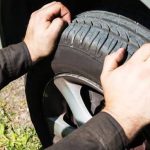
Step-by-step guide to checking and adjusting tyre pressure:
- Find your vehicle’s recommended tyre pressure, listed in the handbook or on the door jamb sticker (this figure differs for front and rear tyres on many vehicles, and changes with full load)
- Remove the valve cap from the tyre
- Press a digital or analogue tyre pressure gauge firmly onto the valve
- Read the pressure and compare it to the recommended figure
- If overinflated, use the small pin on the back of most gauges to release air in short bursts, rechecking frequently
- Replace the valve cap securely once you’ve reached the correct pressure
- Repeat on all four tyres, including the spare if applicable
For step-by-step guidance on other essential tyre maintenance tasks, the full tyre change guide covers safe procedures in detail.
When You Need Professional Help
Sometimes pressure correction reveals a deeper issue. If your tyres keep overinflating after correct adjustment, the valve may be faulty. If you notice uneven wear, cracking, or bulging on the sidewall, the tyre may already be structurally compromised and needs professional assessment.
Any tyre that has experienced a period of significant overinflation should be inspected by a qualified technician. Internal damage to the cords and structure may not be visible externally but can cause sudden failure under load.
If your vehicle has also developed a pulling sensation, unusual vibration, or irregular wear after a period of incorrect pressure, a wheel alignment check is worth considering. Poor pressure management is one of the leading causes of alignment drift over time. For vehicles in the Guildford area, a professional brake and tyre inspection can identify any secondary issues that overinflation may have contributed to.
Conclusion
Overinflated tyres are one of those problems that feel minor right up until they aren’t. The risks accumulate quietly, from reduced grip and longer stopping distances to accelerated wear and the very real possibility of a high-speed blowout. None of those outcomes are inevitable, and every single one of them is preventable.
The fix is inexpensive, takes minutes, and requires no mechanical skill. Keeping your tyres at the correct pressure is one of the highest-impact, lowest-effort things you can do for your safety and your vehicle’s longevity. Make it a monthly habit, adjust for the seasons, and never assume that harder means safer.
Frequently Asked Questions
Is it better to have tyres slightly overinflated or underinflated?
Neither is ideal, but both carry real risks. Overinflation reduces grip and increases blowout risk. Underinflation causes heat buildup, increased rolling resistance, and sidewall damage. The correct answer is always the manufacturer’s recommended pressure.
Can overinflated tyres cause a blowout?
Yes. Overinflated tyres are under excess structural stress and have reduced ability to absorb road impacts. Heat buildup during driving increases the internal pressure further, and a sharp impact like a pothole can cause sudden, catastrophic failure.
How do I know if my tyres are overinflated?
Common signs include a harsh, jarring ride, twitchy handling on uneven roads, visible bulging at the base of the tyre, and centre tread wearing faster than the outer edges. The only accurate confirmation is a tyre pressure gauge.
Does tyre pressure increase when driving?
Yes. Friction and heat generated during normal driving causes the air inside the tyre to expand, increasing pressure. This is normal and is factored into manufacturer recommendations. However, if you start from an already overinflated state, this heat expansion pushes the tyre further into dangerous territory.
How often should I check my tyre pressure?
Once a month as a minimum, plus before any long journey, after significant temperature changes, and any time you notice handling or ride quality has changed. Cold mornings before a journey are the best time to check, as pressure readings are more accurate when the tyre hasn’t been driven on.
Can overinflated tyres affect my brakes?
Indirectly, yes. Overinflated tyres reduce the contact patch between tyre and road, which reduces the friction available for braking. This means your stopping distance will be longer than your vehicle’s systems are designed to achieve, even if the brakes themselves are in perfect condition.